Monday, June 24, 2019

The Global Everything Bubble Is Imploding

"In U.S. financial slang, a bagholder is a shareholder left holding shares of worthless stocks"

Those who don't see the everything bubble, ARE the everything bubble. At this latent juncture, stock gamblers are comforting themselves with the fact that the forward P/E multiple at 17, while high, is still within the normal range. Because this is the point in the cycle when forward profit estimates have the veracity of a Magic 8 Ball, whereby 17 turns back into a negative infinity pumpkin overnight. Leaving all of the true believers in their all too familiar position of holding the bag once again. 


Of all of the bubbles, the biggest and most manipulated by far is the U.S. stock market, prime beneficiary of global money printing, strong dollar asset flows, record stock buybacks, and debt-inflated "GDP". No market in human history has been more fabricated to the benefit of a minority of wealthy insiders.

Here is the set-up going into the G20 meeting at the end of this week. The Dow tanked in May when Trump raised the tariff level on China. Subsequently, the market has rallied back above the pre-escalation level. Despite the fact that the best case scenario envisioned by analysts is another truce. 

The likes of which tanked stocks in December:


Meanwhile, as I've discussed many times, the last stocks making new highs comprise momentum Tech and ("low volatility") bond proxies. 

Recession stocks. 

Which have become crowded trades indeed. Today Goldman was out telling gamblers that these stocks will outperform AFTER a rate cut, even though they've already outperformed before a rate cut. 


As we see below, these stocks on a volatility adjusted basis have been outperforming the market since 2018, posting higher highs even back in December when the rest of the market had already rolled over:


But beyond the recession stock bubble, there also cracks in the facade of the profitless IPO bubble:
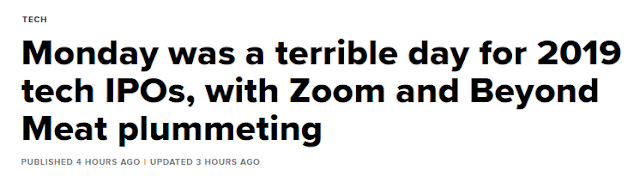


Recall, the 5g trade war bubble was already beginning to implode, but then caught a bid in June for a retracement rally.

Now it's re-imploding into the G20 meeting:


But the real bubble this year is in what else but Bitcoin. Again.

I realize that crypto religious fanatics won't want to hear me say that the lies being told this time around are the same as the lies being told last time around.

The latest fantasy is that this parabolic asset - outperforming everything on the planet is a "safe haven" from trade wars.

Of all of the thousands of ETFs, the Bitcoin ETF is outperforming all of them, by a massive margin, including ALL triple-leveraged ETFs:


This week we learned that open Bitcoin futures contracts reached a new record highWe also learned that the futures market is having an outsized (leveraged) impact on Bitcoin:


Draw your own conclusions.


The most important thing we learned this week is that all of risk is now correlated.

Gamble at your own risk


Deflationary Death Spiral aka. Bull Trap

Given the Pavlovian conditioning for monetary heroin instilled over the past decade, it was inevitable that recession would be met with speculative euphoria. Contrary to ubiquitous belief, low interest rates will not prolong this cycle, low interest rates are ACCELERATING collapse...

Global gamblers are confronted with the competing dichotomy of collapsing growth and increasing central bank monetary heroin. For example in Australia the major stock index just hit the 2008 high, while the Aussie Dollar - key indicator of global growth - is now at cycle lows.

Gamblers are now betting it all that Trump is back on his meds this week:


The key to what is wrong with this pseudo-economy is embedded in this article declaring the death of value investing.

The article states that technology is destroying the competitive advantage - "moats" - of legacy industries. But it's not technology alone doing the damage - it's technology funded with cheap - nearly free capital - that is destroying legacy industries. It's automation with a nearly infinite ROI, compliments of cheap money.  

Meanwhile, these new Tech industries don't create nearly as many jobs as they destroy. Think cloud computing currently devouring its way through legacy IT departments by centralizing technology that used to be distributed across multitudes of organizations. Now taking place across every systems platform from mail and messaging, to collaboration, CRM, Finance, HR, servers, storage. All of it. Which means that these subsidized job destroyers are accelerating economic underemployment, which doesn't show up in the bogus employment rate, but shows up as economic deflation. Which in turn feeds lower interest rates, leading to more "free" automation. 


The article also talks about the low discount rate raising the implied present value of high growth companies. Which again has accelerated collapse. Think Amazon which has had no cumulative net profit for 25 years, yet has been allowed to destroy legacy retail at an "apocalyptic rate". In any other era that was considered predatory competititon. All because it was accorded an outlandish valuation premium and unlimited access to capital. 

To apologists for the system of course, all of this uncreative destruction is merely proof that the system "works" as designed. Not withstanding record amounts of global debt with negative yield (interest rate). Meaning lenders are paying borrowers to borrow their money


Where does it all end?

It ends with the widely believed delusions that low interest rates are "great for stocks" and that "value investing is dead" therefore profits 'no longer matter"- beliefs which have systematically funneled more and more capital into the riskiest high growth momentum stocks. To the point that unprofitable IPOs are now going public at the highest rate since Y2K, and the growth/value premium is the widest on record.

All careening at full speed into the brick wall in the cycle when not only do profits matter, but free cash flow is the ONLY thing that matters. An ever-increasingly more lethal bull trap with no way out, set while gamblers celebrated the return of easy money.

The two words that should never be used in the same sentence by anyone who aims to keep their wealth intact. 


Sunday, June 23, 2019

Easy Money

In a post-truth world, first go the facts, next goes logic and reason. Next comes the crash. Hairless monkeys conflating ignorance and arrogance and the ability to con millions, for omnipotence...

Remember 2016 when Trump used Russians to rig an election? "No collusion" mind you, only harmless foreign assistance to subvert U.S. democracy. How about 2018 when he used a borrowed tax cut to buy the election? Stevie Mnuchin manipulating paycheck withholdings to give the illusion of a larger tax cut. The net result being more Americans owing taxes in April instead of receiving money as expected, which was earmarked to pay bills. What today's total fucking idiots inform us is improved household "cash flow management" by unexpectedly owing money. 

Due to the complicity of Banana Republicans those last two times, this time Trump has been emboldened to up the ante massively by betting the global financial system on 2020. Our lives are now in the hands of an out-of-control megalomaniac, seeking to rig yet another election:


The Time magazine article, here, devotes almost the entire space discussing the unique and unprecedented carnival spectacle Trump believes will drive voters to the polls en masse in 2020 to re-elect his circus. It devotes almost no thought to his economic gambit which is far more ludicrous and parlous than anything else the article describes: Basically bet the entire financial/economic system on trade war brinkmanship by way of achieving re-election. A science fiction fantasy best summarized by Zerohedge, which puts the past year roller coaster ride of non-stop lying and false trade promises into context:

ZH: Trump's Master Plan Is Working

"...the President now views tariff threats as not only a successful negotiating tactic following the immigration agreement with Mexico but also a useful tool in pressing for looser monetary policy. If so, this suggests that the White House will at least threaten further tariff increases and might follow through with some of them."

The cornerstone of the "plan" apparently was to corner the Fed into lubing markets, which appears to have gone swimmingly. Handing Trump the "advantage" he was seeking ahead of this week's G20, while at the same time handing him control over monetary policy.


The operating hypothesis is that collapsing the global economy is now a viable re-election strategy. Which attends the also obligatory assumption that the Fed has control over not just the S&P futures derivative tail wagging the dog, but also the entire $200 trillion+ global asset market.

As Isaac Asimov as all that may seem, the casino class overwhelmingly took the bait.

What they are ignoring is the critical fact that markets have been anticipating a "world of easy money" for six months straight. Gamblers have been well-trained to front-run central banks.

Barron's this week: Double down on growth stocks and high yield plays:


"Just six months ago, it looked as if a decade of ultra-accommodative global monetary policies was ending. Now, interest rates are coming down en masse"

Today, strategists say they are advising clients to buy growth stocks over value names."


"low interest rates are the first to blame for the demise of value investing"

"growth assets are intangible which in many cases are not captured in book value and retained earnings, making the usefulness of book value and earnings questionable”


"My advisor says it's time to get in"
"I read that in Barron's"


Meanwhile, does anyone still remember 2015, when a minor Yuan devaluation sent the S&P 500 limit down and almost imploded global markets? See above.

Picture that scenario entirely out of Fed control across every risk asset class at the same time. Because that we are told is "the plan". 
Now, instead of worrying about Yuan devaluation, we actively short it:


"still see additional tariffs as "more likely than not"


I suppose it was inevitable that a bipolar frat boy operating on Twitter would come to believe that he has dominion over the entire world and everything in it. That by pandering to his base through sheer charismatic bullshit he could be master of the universe. They in turn would feed his manic megalomania through ever-increasing adulation, until such time as the entire system was now a bargaining chip for re-election. While the masses chewed their cud complacently.

Drunken in a world of "easy money" Kool-Aid:  


Buckle up, because all the world is now Trump's bet. And the hegemon is totally out of control.


Barron's
"What makes this different from periods in past cycles—say, right after the financial crisis—is that there is not much left to cut."


"You really have to stay appropriately bullish in the face of nothing but bad news"


"No one saw it coming"


Saturday, June 22, 2019

The Most Important Week Of The Year For Markets

The Fed and ECB did more than their part to lube gamblers ahead of this coming week and the all-important G20 summit. Now it's up to Trump and Xi to do their part. Or not. The stakes have never been higher:

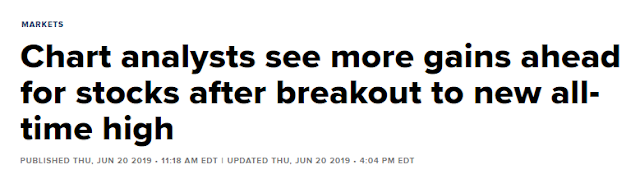
"Stocks" (aka. the S&P 500 aka. Utilities) are having their best first half since the Asian Financial crisis:

"The Asian financial crisis was a period of financial crisis that gripped much of East and Southeast Asia beginning in July 1997 and raised fears of a worldwide economic meltdown due to financial contagion"

Which we are to assume bodes well for the rest of the year. The same way that 2018's best start to a year since 1987 "bode well" for a -20% fourth quarter crash. As always, you can't make this shit up:


"The fate of U.S.-China trade talks could play out in the week ahead, and that could set the tone for markets and the economy in the second half of the year"

Obviously guessing what Trump will do one week from now is a fool's errand of the highest order, however, gamblers are of the belief that either the trade war gets resolved this week, or the Fed cuts rates, either way, it's a "buy".

"Fed Chair Jerome Powell said trade and the global economy are two factors the Fed is watching"


With all of this obvious good news, it's my job to figure out what could go wrong.

First off, Goldman told their clients this week that balance sheet rolloff will likely end sooner rather than later. Which no doubt lubed the casino an additional amount post-FOMC. Is balance sheet cessation priced in? Don't know.

Getting back to the first article above and the binary scenarios under consideration:

“Everybody knows the Trump, Xi meeting could go either way...[BUT] I think everyone expects a new tariff freeze. That the $300 billion won’t go into effect. The most you can hope for out of G-20 meeting is the tariffs are where they are right now, and there’s no more escalation."

Which is exactly what happened last November at the last G20 - a temporary truce, but at a lower tariff level than currently. The casino imploded -10% straight line:


Where the stakes get even higher this time around is that all of this dueling central bank easing is raising concerns over a currency war. A prospect that sent gold and Bitcoin soaring this past week:


"The Bloomberg Euro Index fell after European Central Bank President Mario Draghi said that “ additional stimulus will be required” if the economic outlook doesn’t improve. U.S. President Donald Trump quickly accused Draghi of deliberately trying to weaken the euro, thereby “making it unfairly easier” for the euro zone to compete against the U.S. Draghi responded by saying the ECB doesn’t target the exchange rate. Draghi’s right, but he also knows that all else being equal, easier monetary policy tends to lead to a weaker currency"

The Leuthold Group’s “Defensiveness Indicator,” which in essence measures the performance of gold relative to other commodities and safety-net stocks relative to their more highflying peers, now sits in the top quintile of all readings since 1990"


So, the question on the table, is who wins in the coming weeks - never-ending trade war bullshit, Central bank bailouts, competitive debasement, or the global deflation now being unleashed?


"The last 24 hours has been brutal for the US dollar. The greenback dropped to its lowest level since the beginning of the year against currencies like the Japanese Yen and Swiss Franc"


“One indication that gets overlooked which is really, really bullish historically is the expanding number of 52-week highs” 


Friday, June 21, 2019

Judge Not, Lest Ye Be Judged

When I started this blog in late 2006 I recognized the fate that awaited the lies of that era. I maintained no illusion that I would be spared the relentless meat grinder of corporate profit. I would not be disappointed. My denouement arrived three years ago this coming week. Nevertheless, the commonly accepted approach to understanding 2008's exploded corruption was to double down on fraud, and heighten disdain for those who won't. Such is the love for the consumption lifestyle. The zombies are addicted to consumption, so any thought of pre-emptive downsizing is beyond consideration. For anyone under the age of retirement, especially young people, Trump's wholly fraudulent "greatest economy ever" is the worst economy since the Great Depression -  when measured in terms of wages, underemployment, career advancement, income inequality, job security, healthcare, non-existent pensions, and of course Federal debt - which is now "GDP" according to today's de facto Idiocracy. This pseudo-economy is a force of ever-increasing oppression, to service the needs of a dwindling minority of the ultra-wealthy, and the retirement delusions of Madoff-inspired gamblers.


Having worked 25 years in the IT industry I had seen the highs and lows of the Dilbert world. I lived "The Office", before Steve Carell made it a thing. Over the course of those decades, I re-invented myself many times over. So when the death knell of three serial asset bubbles fell AGAIN in 2016 I faced an all too familiar choice - rinse and repeat. OR, just call it a day. At that point, my Calvinistic side would no longer allow me to continue down the path most followed. So, I headed straight for the ditch.

When I reached my nadir, I contemplated jumping off a bridge. But then it occurred to me that I couldn't take the exact same pain I'd been describing for others, for a decade straight. So I took the pain.

Little did I know how much my self-inflicted crash and burn would upset those around me, as the ripples from my apparent "failure" threatened so many well-maintained delusions of grandeur. After all, if it could happen to him, it could happen to anyone. I had no idea that the values of gratitude and humility I've been espousing for a decade straight, lie so far beneath the swaying heights of the decaying status quo.

I had quit the corporate rat race. And yes, I have never been happier. My life is now measured in moments instead of blurred years. It's all great, aside from those awkward times when I am forced to explain why I quit the rat race. They still don't get it. Far more eager to race to judgment than to acknowledge the inherent fraud of this era. My new life is anathema to the consumption status quo - the obligatory assumption that every day brings "more", even when the erstwhile American Dream has been strip mined down to robbing Peter to pay Paul.  

Now I do gig work - on my own terms, with some trading on the side. No stranger to efficient lifestyle. 

Got me so far?

It's not the end of the world. It's the beginning.

Make no mistake, it's not for everyone. Those who view the accumulated liabilities of their consumption lifestyle as memorial to a lifetime of achievement, won't make the turn. That all has to go overboard post haste, or the ship sinks very quickly. Like it or not, the sharing economy is the future, those who fight it will learn the hard way - having learned less than nothing from 2008, other than to double down on fraud and heighten their disdain for those who don't. 

And yes, I am always long brick shitting volatility. Because someone has to be right at the end of this fraud. And if it's one thing I won't tolerate, it's being conned yet again, by even bigger lies and liars than last time. And the time before. 


Everybody Plays The Fool

This post-2008 mega bubble has lasted just long enough to make everyone look stupid - bulls and bears alike. The inevitable consequence of Japanification gone global - to believe in financial Disney World, or to bet against the 7 billion people who do. Today's Madoff-inspired policy-makers have given no thought as to what fragments of public trust will remain, when this experiment final explodes. In the meantime, plausible deniability is the opiate of the profoundly stoned masses...


What a fool believes he sees
No wise man has the power to reason away
What seems to be
Is always better than nothing


I had to jump my usual format of rambling tirade to timestamp this madness for posterity. No archaeologist will believe this insanity, without proof.

The power of the Financial Services crime syndicate over all aspects of this society, is overwhelming. Today's musical chairs dancing pundits need to keep this party going by all means possible. 


The article attempts to explain that the derogatory term "bubble" is being over-used to deride perfectly legitimate Ponzi schemes. Then it cops out completely by saying that bubbles are only ever visible in hindsight: The Nassim Taleb "Black Swan" argument that gave creative license to package subprime garbage into AAA-rated bonds, so Wall Street could claim "no one saw it coming". And every duped idiot would gladly believe them. 

Fortunately, my definition of a bubble is far more simplistic and indefensible: Any time one is buying an asset that has no intrinsic value, simply because other fools are buying it, that is a bubble. Say for example a stock market inflated by central bank printed money, and debt-fueled stock buybacks, when corporate credit is at record highs as % of GDP, amid collapsing economic fundamentals and record insider selling


"CNBC’s Jim Cramer says he expects most companies to post weaker earnings than they did last quarter.
“I literally do not have a company that is having a better quarter,” Cramer says.
But against that backdrop, the Dow opened less than 1% away from its record close. The S&P 500 on Thursday closed at an all-time high."


Which gets us to a selection of my most bearish charts that are strangely visible before-the-fact:

The Dow is now approaching the October 2018 closing daily high, which perfects the broadening top on the weekly view.

As we see, short-term rates took another leg down this week. RSI (top pane) was multi-decade overbought in January 2018:


Global Dow and Vol:


Average stock and vol:


"Safe havens"


Breadth:


World versus U.S.:


Bonds versus stocks. Not everyone gets to be right in the end. 


"If reading financial markets is usually as inscrutable as reading tea leaves, bond investors have decided now is the time to send a message in big, bold letters"

Meanwhile, the expectation of more stimulus has helped push stock markets close to record highs"


"No one was allowed to see it coming"


Monday, March 11, 2019

Ponzi World Is Ending

The third false rally of the third false bubble. Only the most dedicated denialists don't see this coming aka. going. Having learned nothing from their last clown, this one was sent to finish the job...

"In the broadening top formation five minor reversals are followed by a substantial decline....It is a common saying that smart money is out of market in such formation and market is out of control."


Mass shootings, fentanyl suicides, industrial-scale human trafficking, biblical climate change, de facto global slavery. Life in a human toxic waste dump. One clown to rule them all. Looking back at past decades, Disney Trump was a step migration along America's journey from land of opportunity to land of opportunism:

"Opportunism is the conscious policy and practice of taking advantage of circumstances – with little regard for principles or with what the consequences are for others."


Labels:
Ponzinomics, Entropy, Fraud, Corruption, Denialism, Artificial Intelligence, Fake News, Globalization, Environmental desecration, Corporatism 

In order to keep my most recent posts near the top of the blog, this post will be an open-ended stream of consciousness. The most recent ramblings will be at the top. 


Date: June 20th, 2019
Label: Denial Is Not A Black Swan Event


Humankind's only natural enemy is itself - both at the individual and societal level. A self-destructing adversary equal to the task. Complacency and denial are this species' greatest weaknesses. Contrary to popular belief, one-time unexpected "Black Swan Events" don't bring down markets. Both 9/11 and Pearl Harbor were excellent buying opportunities. What brings down markets is long periods of tranquil complacency attended by mass denial and the accumulation of unsustainable imbalances - the likes of which we've seen like never before, in this cycle. If a marathon runner has a heart attack, that is a black swan event. If a four hundred pound fat man has a heart attack, that is a long overdue event. This society is a four hundred pound fat man sprinting to McDonald's for another Fed-sponsored Happy Meal.  

Which gets us to this seminal week with gamblers doubling down on escalating real wars, trade wars, and recession, ahead of the most important global trade meeting of the year next week. 

What happens when the perceived lowest risk stocks in the market turn into momentum plays? We're about to find out:


"The slowing economy and increasing market uncertainty have made low-volatility stocks a popular choice for investors this year. They’re likely to stay that way"

The asymmetry in upside participation and downside protection has contributed to what academics call the “low-vol anomaly”

Stocks in the Invesco Low Volatility ETF are trading at 22 times earnings in the last 12 months, higher than their five-year average and the S&P 500’s 18.6 times.

"valuation should not be a concern as long as demand remains high"

Got that? As long as valuation keeps rising, valuation is not a concern. Just ask Bernie Madoff.

As the market top has progressed, more and more money has rotated into this "low-vol" anomaly, causing massive outperformance relative to the average stock. Just two ETFs account for 50% of U.S. fund inflows in 2019. Yes, you read that right.


Getting back to the broader casino, ahead of next week's make-or-break G20 summit, gamblers are euphoric:


The number of lies getting bought with both hands right now is extreme even by Idiocratic standards. All on the flimsy promise of more Fed dopium sometime in the future.

Among today's easily refuted obligatory false beliefs:

1) The tax cut extended the cycle 

2) The trade war will be over soon

3) A Fed rate cut is for "insurance" only - great for stocks, and not indicative of recession

4) A weakening jobs market is great for stocks

5) War with Iran is also great for stocks - higher oil prices etc. 

6) The world can implode, the U.S. will be the sole beneficiary


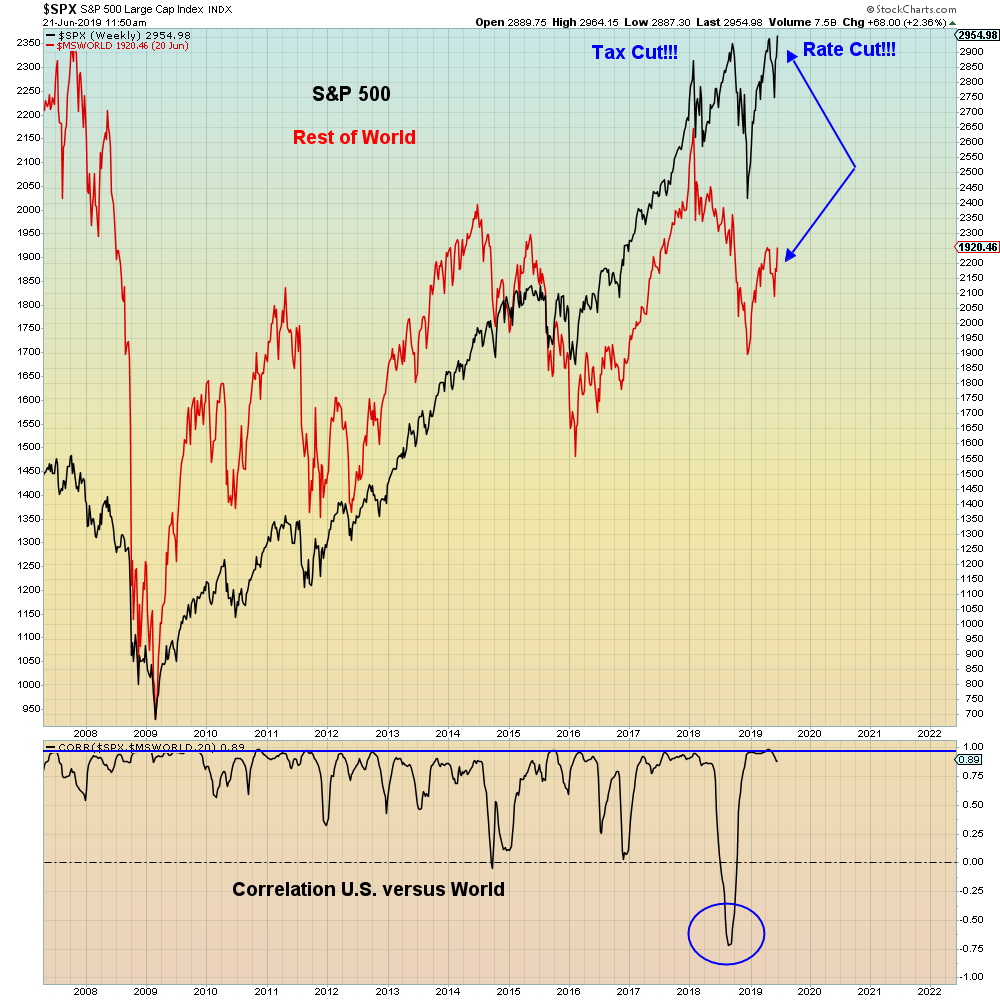
Of all the mega lies, this last one is by far the most delusional, now abetted by the S&P at new all time highs. The gap between the U.S. and the rest of the world, is record wide. 

On the assumption that what is bad for the rest of the world, is good for the U.S.:


Even within U.S. markets the divergences among sectors are chasmic. The only sectors at new highs are the "low volatility" recession bond proxies - Utilities, REITS, Staples. 

The Dow and Nasdaq are not confirming.


Economic cyclicals - banks, transports, autos, retail, are lagging massively:


U.S. Manufacturing PMI lowest since September 2009 (My data only goes back to 2012):


Here we see the small cap Russell 2000 with rising Nasdaq declining volume deja vu of last cycle:


The fake news this week was that professional investors are the most bearish since 2008:


What the article should have said is that investors would like to be as bearish as 2008, but it's not their money, so why hedge? Instead, invent a new imagined reality and pretend no one saw it coming. 

In October 2008, the VIX hit 90. Today it hit a 13 handle at the open. There is no comparison on bearishness between then and now.


Also on the subject of bearishness, the profitless IPO ETF has now more than DOUBLED the performance of the S&P year to date (40% versus 18%). While many of the recent IPOs have doubled in a matter of days. Which makes this more of a Y2K-style blow-off than a 2008-level buying opportunity:


“The important theme here is called growth, and investors are looking for growth companies in a slow-growing economy"


Here we see via momentum Tech, that momentum begets more momentum. 

And then crash


In summary:


Date: June 19th, 2019
Label: The Alchemy Of Finance

Those who are concerned about MMT: Modern Monetary Theory - have yet to learn their lesson about the risks from Modern Financial Theory:

Unbounded greed is destroying the economy.

Way back in Y2K, hundreds of unprofitable DotCom companies went abruptly bankrupt when financial markets cut off their funding going into recession. The height of the bubble was 1999 - almost ten years into the longest economic expansion in U.S. history - yet most of those companies were not built to survive one year without needing additional capital. Of course we now know that the bubble was the end of the cycle, not the beginning of a new bull market as everyone believed at the time. 

A few years later during the housing bubble, lending conditions eased as the cycle progressed and as risks grew, until mortgage lenders abruptly went bankrupt en masse as the credit markets slammed shut at the end of the cycle.

July 2007:


The Citigroup chief executive told the Financial Times that the party would end at some point but there was so much liquidity it would not be disrupted by the turmoil in the US subprime mortgage market.

He denied that Citigroup, one of the biggest providers of finance to private equity deals, was pulling back.


“When the music stops, in terms of liquidity, things will be complicated. But as long as the music is playing, you’ve got to get up and dance"


In this cycle of non-existent real economic growth, many large corporations will go bankrupt en masse when credit markets once again slam shut. For the exact same reason - rampant greed leading to non-existent management of cycle risk.

Led of course by Energy, but no means limited to that sector:


Modern Finance STILL does not acknowledge cycle risk. In the Finance textbooks, the business cycle doesn't exist. In the discounted cash flow model, the cycle is not a factor in the equation.  Which is why as the cycle progresses companies onboard greater and greater leverage. Because corporate profit must continue to grow to maintain share price appreciation. 

Which is why right now, nearing the longest expansion in U.S. history - all major companies are leaning hard into credit markets to fund stock buybacks to offset declining profits. Once again, failing to acknowledge and manage cycle risk by reducing leverage as the cycle progresses.

How big are stock buybacks? Put it this way, on a market cap basis, the S&P peaked last October, not in April. 


"The decade-long economic expansion, poised to become the longest in U.S. history next month, is facing an existential question: Will it sputter to a halt by next year or keep on chugging at the same modest pace that got it this far?

On the one hand, the expansion is displaying some telltale signs of old age, such as the 3.6% unemployment rate, a 50-year low; the beginnings of a slowdown in business profit growth; and a mounting debt problem – this time inside corporations."


As I write, the FOMC just rendered their decision to leave rates unchanged. Which means that algos are now unwinding their volatility collars. The real market trend won't be known until tomorrow. 


All we know is that bond markets see something that stock gamblers and the Fed STILL don't (want to) see.


"Fannie Mae and Freddie Mac, the dominant players in the market, both have been taking on more risk “steadily since the financial crisis.” The Federal Housing Administration (FHA), Department of Veterans Affairs (VA) and the Agriculture Department’s rural home loans program have pushed risk to “the highest level since 2009.”


Median home price ($$), blue:
Short-term rates, red: